
Evolution.
It was the early 1980s, and I thought I had a clue.
I didn’t.
Forty-odd years ago, as a senior in high school, I wandered into the brand-spankin’-new computer lab and watched the guys tapping away at keyboards, staring at some golden alien language glowing on green-black screens.
Them: “You have to get into computer programming, Pat. It’s the future!”
Me (with misplaced bravado): “I don’t need computers. I’m going to be an ARTIST!”
Some angel on the other side of the veil laughed and said, “Bet.”
What I know for sure is this: computers did not make my life easier—but they absolutely made it busier. And what a hell of a ride it’s been.
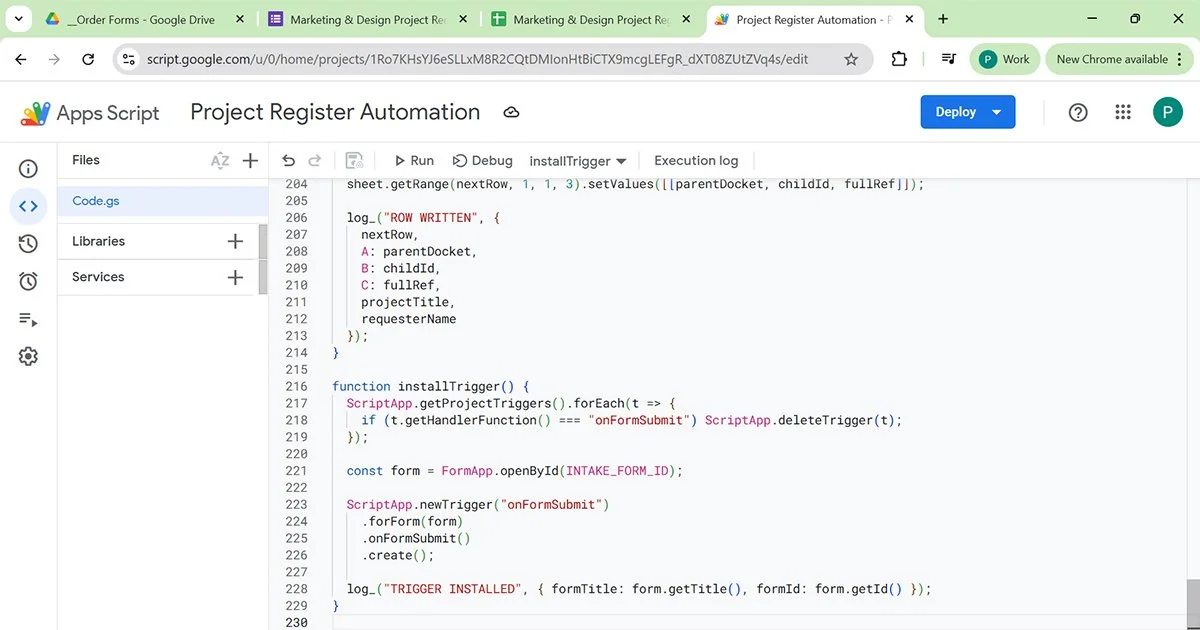
I still don’t know how to code. But I do have the gifts of Resolve and Determination in my Gene Keys—and I leaned hard on them to make this happen. After a few intense conversations with ChatGPT, I now have a seamless, form-to-spreadsheet project intake and docket management system running inside Google Workspace at my full-time job.
No training. No background. Just persistence and pattern recognition.

“Hold on… I thought you were a designer,” you say.
I am.
That—and more.
I may have started as an artist, but the tools have changed dramatically over the decades: ruling pens, French curves, handset lead type, desktop publishing, and now AI. They’re just tools. Form still follows function, no matter which hammer you swing.
Until recently, I used computers primarily for creative work—writing, design, illustration. This past week, though, I used AI for the kind of backend work my classmates insisted I’d need forty years ago.
And honestly? That’s where this tool shines for me.
I handle the creative vision. AI helps keep the gears turning in the background.
Because that’s the other half of my gifting: creative problem-solving. Finding the systems, structures, and solutions that allow creativity and productivity to flow—without friction.
Think of it like a steam engine. Steam has power, but without a sealed cylinder to direct it, that energy dissipates. Structure doesn’t stifle creativity—it amplifies it.
After hours of tearing things down and starting over, I finally have function supporting form.
Before this, people came to my office with requests. I scribbled notes. Paper migrated between desks and home offices. Or my inbox filled with loosely defined “quick asks” and vague urgencies.
Now, I can share a single link that allows us to:
request marketing or design projects properly
set realistic timelines and expectations
track accountability and responsiveness
manage everything in a centralized docket system
And this was only phase one.
Next, the system will:
auto-create project folders in Google Drive and write links back to the tracker
trigger email follow-ups (because “rush” projects without sign-off are a nightmare)
flag time-sensitive assignments before they fall through the cracks
generate dashboard roll-ups by department and project type
manage recurring project clones
This is how ease is built.
OK… so why are you telling us this?
A few reasons.
First—if you ever feel tempted to toss around “boomers don’t get computers,” don’t do it near me. I’m over 60, and I built this. Step one of a complex, integrated project management system. Zero formal training. Just grit, curiosity, and follow-through.
(Also, for the record: I’m Gen X. I genuinely do not care what anyone thinks about that.)
Second: AI is what you make it.
I resisted it at first—especially the intrusive “let me rewrite that for you” nonsense. No thanks. Then one day I was stuck, spinning my wheels, and thought, Fine. Let’s see what happens.
That was all it took.
Just like my first nights wrestling with PageMaker in 1988, I knew what I wanted to build—and I stayed with it until it worked. The difference? This tool actually reminded me to take breaks when I got frustrated. Something I rarely give myself permission to do.
AI isn’t inherently evil. People can be though. Most folks will simply use it to make complex things more accessible.
Adapt—or get left behind. That’s evolution.
After four decades in production-oriented work, I’m leaning fully into my actual gifts. Every system I’ve studied—Gene Keys, Human Design, personality profiling—points to the same truth:
I’m built for ease, not endurance.
Everything in my charts screams, “Stop working so hard.” (My family agrees.)
Over the last three years, I’ve learned why exhaustion and depression have been such frequent companions—and how to loosen their grip. I’ve learned the power of “no.” I’ve learned to trust synchronicity. I’m not retiring; I’m repurposing.
Resolve. Determination. Versatility. Equality.
I stepped into something I was completely untrained for. I adapted. I rebuilt. I integrated creative vision with technical execution. This is exactly how I’m wired to operate.
Which brings me to the unapologetically promotional part.
Yes, I’ve designed, written, illustrated, and launched beautiful things. I’ve led campaigns and coordinated events. But my real value—the part I’m done hiding—is this:
I help people find clarity inside their confusion.
I see the pattern beneath the spin. I ask the questions that expose what’s actually blocking momentum.
Stuck getting a business off the ground?
Unsure how—or where—to market an offer?
Hitting an invisible revenue ceiling?
Trying to build structure without boxing yourself in?
That’s my lane.
Let’s talk.